


Found an old, colorful Flinch box in the closet and have no idea how to play? You’re in the right place. First patented over a century ago, Flinch is a fast-paced classic that looks more complicated than it is. This guide gets you from shuffling the deck to shouting “Flinch!” at your friends in just a few minutes. To find more, check on Login megaxwin
Unlike other card games where you might count points or collect sets, winning Flinch has one simple, singular goal. Your entire mission is to be the first person to get rid of a special 10-card stack called your Flinch Pile. Every action you take, from playing a “1” to starting a new pile, is all about emptying that stack before anyone else can.
This guide to the Flinch card game rules walks you through the essentials step-by-step. We’ll show you exactly how to set up the playing area, what to do on your first turn, and the strategy behind the game’s most important piles. Forget the confusing old rulebook; let’s get your first game started now.
What’s in the Box?: Understanding the Flinch Card Deck
Opening up the Flinch card game reveals a surprisingly large stack of 150 cards. You’ll notice there are no suits—no hearts, diamonds, or spades to worry about. This design choice makes the official Flinch rules straightforward, as your only focus will be on the numbers.
The entire deck is composed of cards numbered 1 through 15, with ten copies of each number. Having so many duplicates, especially of the low numbers needed to start piles, ensures the game starts quickly and keeps a rapid pace. With the deck understood, it’s time to deal the cards.
Game Setup in 5 Minutes: How to Deal and Arrange the Piles
With the 150-card deck shuffled, you’re just a few steps from starting your first game. The initial deal is quick and creates the unique starting layout for Flinch. Pick one person to be the dealer, and they can follow these simple steps for every player at the table.
The dealer will distribute cards to form two crucial parts of your playing area:
- First, deal a stack of 10 cards face-down to each player. This is your personal Flinch Pile, and your main goal is to be the first person to play all ten of these cards. Once everyone has their pile, flip the top card face-up.
- Next, deal 5 cards to each player to form their starting Hand. Keep these cards secret from your opponents, as you’ll use them to make strategic plays.
- Place the remaining deck face-down in the center to create a communal draw pile.
At this point, your personal area should have your 10-card Flinch Pile (with one card showing) and your 5-card Hand. It’s a good idea to leave empty space beside your Flinch Pile for your discard stacks (Reserve Piles) and plenty of room in the middle of the table for the piles everyone will build on together.
That’s all there is to the setup! Now that the cards are dealt and the table is arranged, you need to know the specific job of each of these different stacks.
Your Player Area Explained: The Four Piles and Their Jobs
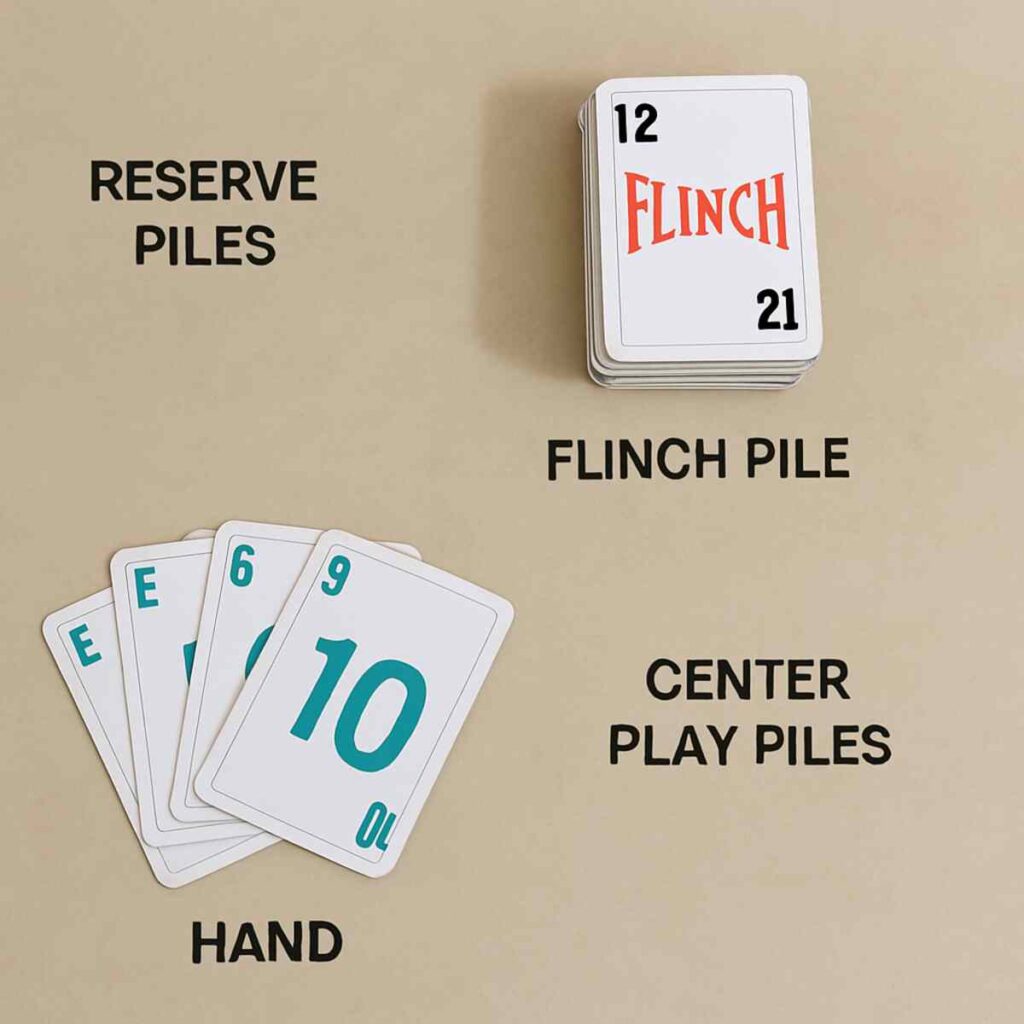
With your cards dealt, you’re looking at a few different stacks. Understanding the job of each one is the key to playing Flinch. The two you already have are your Flinch Pile—the 10-card stack you must get rid of to win—and your five-card Hand, which gives you secret options to help you make plays.
As the game begins, two new types of piles will appear. The first are your Reserve Piles, which are your personal discard piles. At the end of your turn, you’ll place one card from your hand face-up on the table in front of you, starting your first Reserve Pile. You can have up to five of these piles, and just like your Flinch Pile, the top card of any of your Reserve Piles is always available to be played.
In the center of the table, all players will work together to build the shared Play Piles. This is where the real action happens. Any player who has a “1” card can use it to start a new Play Pile. From there, players build on any available pile in sequence: a 2 on a 1, a 3 on a 2, all the way up to 15. Once a pile reaches 15, it’s removed from the game.
You have three sources to play cards from (your Flinch Pile, your Hand, and your Reserves) and one destination to play cards to (the central Play Piles).
How to Take a Turn: The 3 Places You Can Play From
The moment it’s your turn, all eyes are on one card: the top card of your Flinch Pile. This is the single most important rule in Flinch. Before you even glance at your hand, you must check if this card can be played on any of the central Play Piles. If a legal move exists—for example, your Flinch card is a 9 and there’s a Play Pile showing an 8—you must play it. Playing from your Flinch Pile is always your first and highest priority. Once you play it, immediately flip over the next card in the stack, and your turn continues.
After you’ve played from your Flinch Pile (or determined you can’t), your turn opens up. A single turn can involve playing multiple cards in a row from any of your legal piles as long as you have moves available. Your options are:
- Your Hand: The five cards you hold.
- Your Reserve Piles: The top card of any of your personal discard piles on the table.
For instance, after playing that 9 from your Flinch Pile, you might see you have a 10 in your hand. You can immediately play it on top of the 9. Then, you might notice the top card of one of your Reserve Piles is a 4, which you can play on a 3 in the center. You keep going until you have no more moves.
When you’ve made all the plays you can and are stuck, your turn ends. You must choose one card remaining in your hand and place it, face-up, onto one of your Reserve Piles. You can either start a new Reserve Pile (if you have fewer than five) or place it on top of an existing one. This action officially ends your turn, and play passes to the player on your left.
The Heart of the Game: How to Start and Build Play Piles
The shared space in the center of the table is where the action happens, and it all starts with the number 1. According to the official Flinch rules, a new Play Pile can only be started with a “1” card. If you have a 1 on top of your Flinch Pile, in your hand, or on a Reserve Pile during your turn, you can place it in the center to begin a new pile. Up to ten of these piles can be active at once.
From there, building a pile is straightforward. Players must add cards in sequential order, from 1 all the way up to 15. For example, if a Play Pile shows a 6, the very next card played on it by any player must be a 7. These central piles are communal property, creating a fast-paced race to play your cards before an opponent does.
Once a player places a 15 on top of a stack, that Play Pile is complete. It is immediately removed from the play area and set aside. This not only signifies progress but also frees up valuable space in the center for someone to start another pile with a fresh “1” card.
The “Flinch!” Penalty: A Costly Mistake to Avoid
The game gets its name from a specific, painful penalty, so paying attention is critical. A “Flinch” occurs when a player misses a mandatory move. You must play a card if a legal move is available from the top of your Flinch Pile. The most common flinch, however, happens when a player has a ‘1’ in their hand or on top of a Reserve Pile but ends their turn without playing it to start a new central Play Pile. If you could have made a play but didn’t, you’ve flinched.
Spotting an opponent’s mistake is your chance to get ahead. If you see another player make this error, you can immediately shout “Flinch!” The penalty is simple but effective. The player who calls “Flinch” takes the top card from their own Flinch Pile and gives it to the player who made the mistake. The offending player must then place this new card on the bottom of their own Flinch Pile. This makes your pile grow larger while your opponent’s shrinks, pushing you further from victory.
This rule adds a layer of excitement and vigilance to the game. It forces every player to pay close attention not only to their own cards but to everyone else’s turn as well. Always check for any available ‘1’s in your hand or Reserves before you discard. Avoiding this penalty is crucial to emptying your Flinch Pile.
How You Win the Game (And How to Score for a Rematch)
The path to victory in Flinch is wonderfully straightforward: be the very first player to get rid of the last card from your Flinch Pile. The moment that final card legally lands on a central Play Pile, the game is over instantly. You’ve won! There’s no need to finish the round or count up any other cards.
If you want to turn Flinch into a longer-lasting challenge, keeping score is the way to go. The winner of the round earns one point for each card their opponents failed to play from their Flinch Pile. After a player wins, every other player counts the cards left in their own Flinch Pile, and the winner scores one point for each of these cards combined.
Typically, players will set a target score, like 50 or 100 points, before the first game begins. The first person to reach that score over several rounds becomes the overall champion. This scoring system adds a fun, competitive edge, especially when one player wins a round just before another was about to go out.
Flinch vs. Skip-Bo: Unpacking the Key Differences
If Flinch feels strangely familiar, you’ve likely played its modern cousin, Skip-Bo. Both games share that same exciting race to empty a personal stack of cards—your Flinch Pile here, or a Stock Pile in Skip-Bo. While they come from the same family, a few key distinctions give Flinch its own classic and sometimes chaotic personality.
The most significant difference lies in your personal discard piles. Where Skip-Bo gives you four rigid piles, Flinch offers up to five flexible Reserve Piles. This is a game-changer: you are free to play the top card from any of your five Reserve Piles at any time, creating far more opportunities to make a play and keep your turn going.
You’ll also notice the deck itself is different, running from 1 to 15 instead of Skip-Bo’s 1 to 12. More importantly, Flinch has the “Flinch” penalty, which punishes players who hesitate or miss a necessary play. This adds a layer of constant attention that doesn’t exist in Skip-Bo. Ultimately, these rules make Flinch a faster, more opportunistic game compared to Skip-Bo’s methodical pace.
Quick Answers to Common Flinch Questions
Even with a solid grasp of the rules, every card game has its “what if” moments. Here are definitive answers to the most common questions.
- Can you play Flinch with only two people? Absolutely! Playing Flinch with two people is a fantastic way to experience the game. The rules do not change. The game simply becomes a faster, more intense head-to-head battle to empty your Flinch Pile first.
- Can you play on your own discard pile in Flinch? This is a common point of confusion. The answer is a firm no. Your Reserve Piles are sources, not destinations. You can only play the top card from any of your five Reserve Piles onto the shared Play Piles in the center. You cannot build sequences on your own discards.
- Are the vintage Flinch game instructions different? The core goal of the game has always been the same. However, you may find minor variations in older rulebooks, such as different penalties or card counts. For your first game, sticking to these standard modern rules is the best way to ensure a smooth experience.
Getting these points straight—especially the crucial rule about not building on your own Reserve Piles—will prevent most debates and keep the game moving.
You’re Ready to Play: How to Start Your First Flinch Game Now
Just a few minutes ago, that colorful deck of cards was a mystery. Now, you’re ready to deal your first hand. The entire game boils down to a simple rhythm: try to play from your Flinch Pile first, then your Hand or Reserves. If you can’t make a play, discard one card to end your turn.
The best way to make these rules click is to put them into practice. Don’t worry about playing perfectly on your first try; the real fun is the fast-paced race to empty your pile. So gather your players, shuffle the deck, and dive in. Your first game is waiting.