


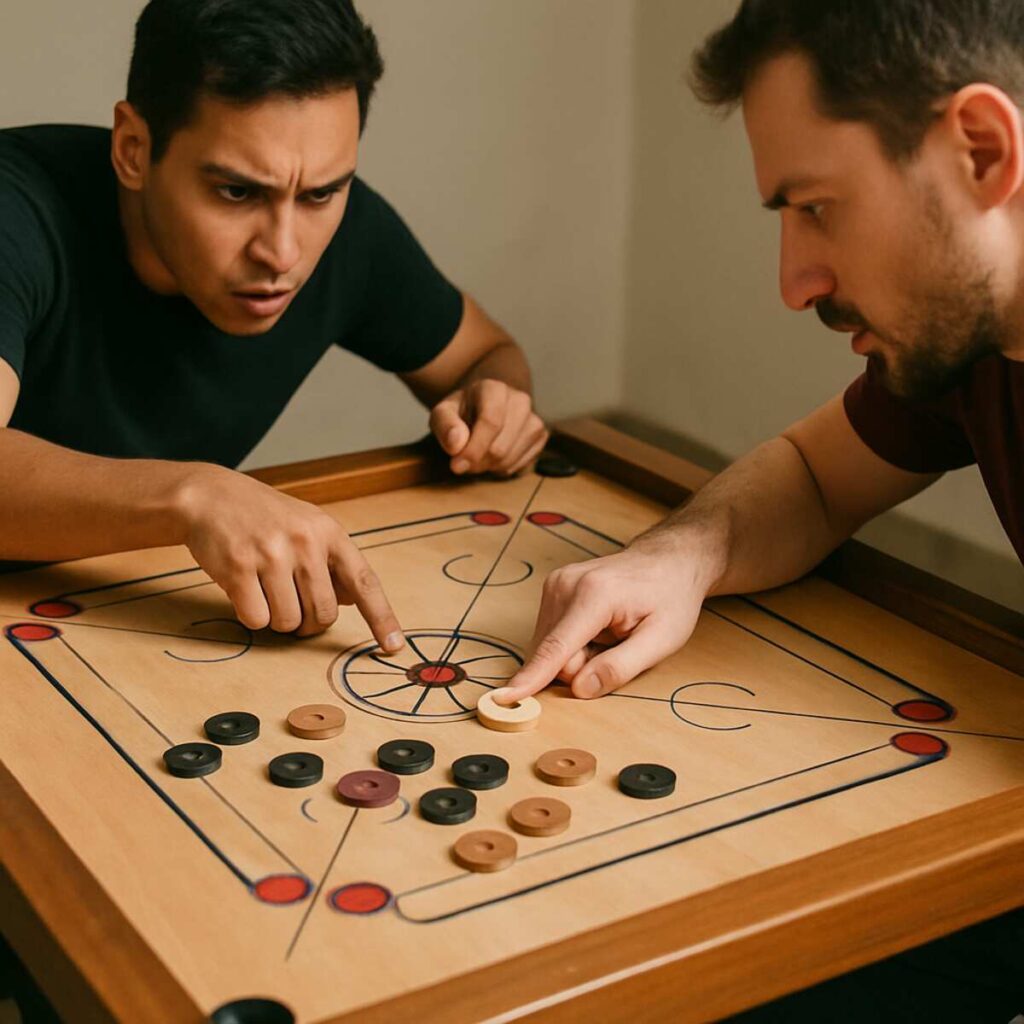
Whether you are gathering around a wooden board with family on a Sunday afternoon or preparing to compete in a high-stakes regional tournament, Carrom is a game that beautifully marries precision, strategy, and finesse. Often described as a tabletop blend of billiards and shuffleboard, this classic game has captivated millions around the globe. The Amazing fact about slot online resmi.
However, transitioning from a casual basement player to a competitive striker requires more than just a good flick of the finger. It demands a comprehensive understanding of Carrom game rules and regulations. While house rules are fun, knowing the official guidelines elevates your gameplay, ensuring fairness, consistency, and a deeper appreciation for the sport.
In this exhaustive guide, we will dive deep into every facet of the game. From the precise physics of the board to advanced striking techniques, you will learn everything you need to master official carrom rules.
1. What is Carrom? A Brief Overview
Originating in the Indian subcontinent, Carrom (sometimes spelled Carum, Karrom, or Caram) is a tabletop game that requires players to flick a heavy disc, known as the “striker,” to knock lighter discs, known as “carrom men” or “coins,” into one of four corner pockets.
The objective sounds simple: be the first player (or team) to pocket all your designated coins (either white or black) while also strategically securing the red coin, known as the “Queen.” Yet, beneath this simple premise lies a labyrinth of geometric calculations, defensive play, and strict adherence to Carrom game rules and regulations.
2. The Anatomy of the Game: Equipment and Specifications
Before you can play the game properly, you must understand the arena. Professional Carrom is not played on just any piece of wood. The equipment must meet rigorous standards to ensure fairness and predictable physics.
International Carrom Federation Board Specifications
To play at a competitive level, your board must adhere to the International Carrom Federation board specifications. The ICF outlines exact measurements to guarantee that tournaments worldwide offer a standardized playing experience.
- Playing Surface: The official playing surface must be perfectly flat, made of high-quality plywood (often English birch), and measure exactly 73.50 cm to 74 cm (29 inches) square.
- Thickness: The plywood must have a minimum thickness of 8 mm, though professional boards often feature 16 mm to 24 mm thicknesses to ensure optimal rebound and prevent warping over time.
- The Frame: The wooden frame surrounding the playing surface must be between 1.9 cm and 2.54 cm above the playing surface. This frame provides the crucial “cushion” for rebound shots. The inner width of the frame should be between 6.35 cm and 7.60 cm to allow players to rest their hands comfortably during baseline shots.
- Pockets: The four corner pockets must have a diameter of 4.45 cm. Beneath each pocket, a small net is attached to catch the coins.
- Baseline and Arrows: The playing surface features painted lines. The baselines (from which players strike) feature two parallel lines. The diagonal lines (foul lines) run from the baselines toward the pockets.
The Coins, Queen, and Striker
A standard Carrom set consists of 19 coins (9 white, 9 black, and 1 red Queen) and one striker.
- Carrom Men (Coins): Made of high-quality wood. They must have a uniform diameter between 3.02 cm and 3.18 cm and a thickness between 7 mm and 9 mm. Their weight should perfectly balance between 5.25 grams and 5.50 grams.
- The Striker: This is the cue ball of Carrom. The standard weight and diameter of a professional striker are strictly regulated. A tournament-legal striker must weigh no more than 15 grams and have a diameter of no more than 4.13 cm. Unlike wooden carrom men, strikers are typically made of hard, smooth acrylic or ivory substitutes to prevent chipping and ensure a frictionless glide.
The Magic Dust: Carrom Powder
You cannot play Carrom efficiently on a dry board. Players use a specialized powder to reduce friction. Understanding the impact of boric powder on gameplay speed is essential for any serious player.
Historically, players used fine boric acid powder. When spread evenly, this micro-fine powder fills the microscopic pores in the wood, creating an almost frictionless, glass-like surface. The impact of this powder is profound: a striker flicked with moderate force can ricochet off three or four cushions before losing momentum. Today, while pure boric acid is still common, many federations recommend non-toxic, anti-static, plant-based powders (such as refined potato starch) to achieve the same lightning-fast gameplay without the health concerns associated with inhaling boric dust.
3. Preparing for Battle: Carrom Setup
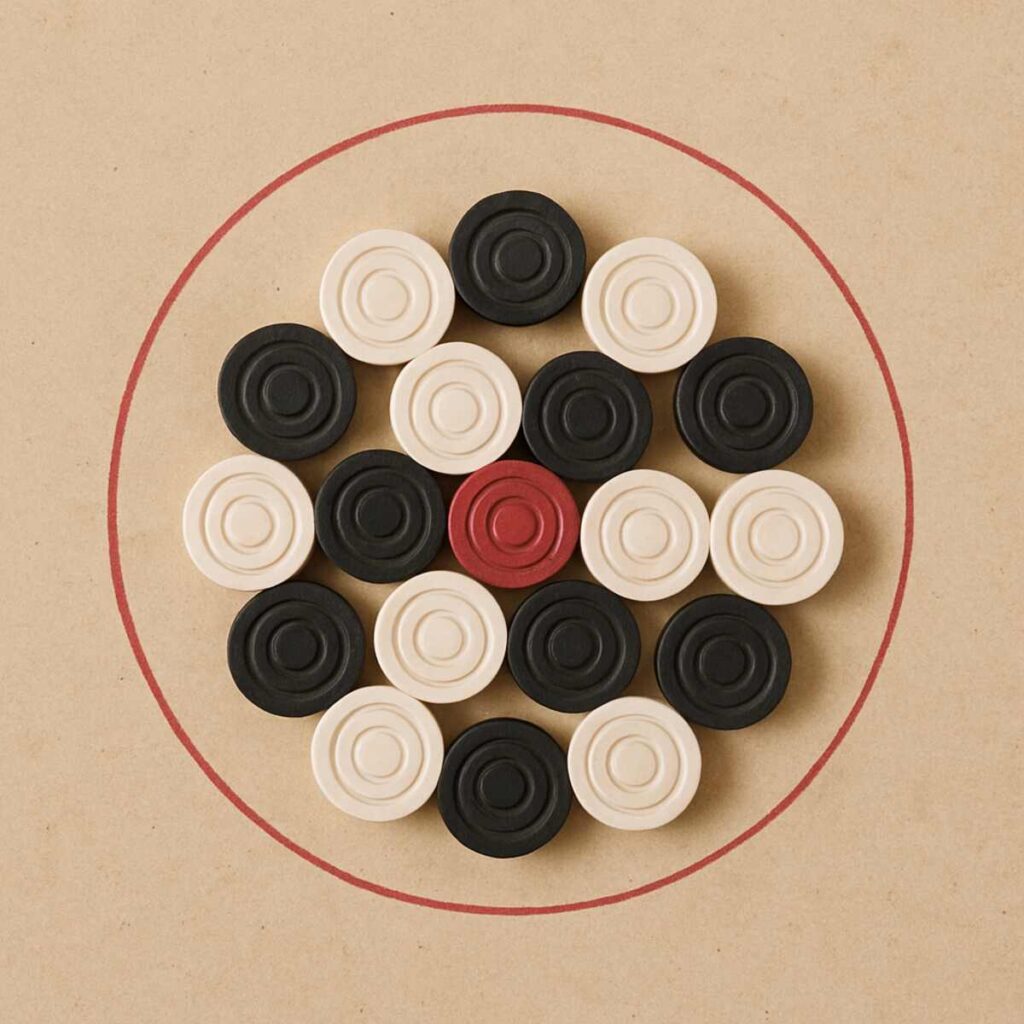
A proper match begins with a precise carrom setup. The way the coins are clustered in the center circle significantly impacts the opening break shot.
Correct Arrangement of Carrom Coins on the Board
The initial arrangement is highly specific. Place the red Queen directly in the dead center of the board. Next, surround the Queen with six coins in a circle, alternating black and white. Finally, arrange the remaining 12 coins in an outer circle, ensuring that the entire formation fits neatly within the board’s outer center circle.
The correct arrangement of carrom coins on the board forms a recognizable “Y” shape when looking at the white coins. It is vital that the coins are packed tightly against one another; a loose pack will absorb the kinetic energy of the break shot, resulting in a poor spread.
4. Basic Gameplay Mechanics
With the board prepared and powdered, the game can commence. In a singles match, two players sit opposite each other. In a doubles match, teammates sit opposite each other, taking turns clockwise.
The Break Shot
A coin toss usually determines who breaks first. The player who wins the toss chooses to play either white or black. The player who breaks always plays white.
Executing the opening strike is critical, but you must adhere to the legal requirements for a break shot.
- The striker must be placed on the baseline directly in front of the player.
- The striker must either touch both parallel baseline lines simultaneously OR sit completely within the red base circle at the end of the line.
- The striker cannot touch the diagonal foul lines at the corner of the baselines.
- The player must flick the striker forward to scatter the coins clustered centrally. If the striker fails to leave the baseline, it is a foul, and the turn passes.
Turn Mechanics and Strikes
After the break, the objective is to pocket your designated colored coins.
- If you successfully pocket one or more of your coins, you get another strike.
- If you fail to pocket a coin, your turn ends, and the next player steps up.
- You must strike the striker with a flicking motion of your finger. You cannot “push” or “shove” the striker. The finger must cleanly flick away from the hand.
5. The Queen: Rules, Strategies, and Edge Cases
The red coin—the Queen—is the most valuable piece on the board and the source of the game’s most intense strategic battles. Pocketing the Queen is a badge of honor, but it comes with strict stipulations.
Pocketing the Queen and Cover Rule
You cannot simply pocket the Queen and claim the points. According to official rules, a player must “cover” the Queen. The pocketing the queen and cover rule states that immediately after a player pockets the Queen, they must pocket one of their own coins on the very next consecutive strike.
If they successfully pocket their own coin, the Queen is officially “covered” and belongs to that player. If they fail to pocket a cover coin on the next shot, the Queen is not secured.
What Happens When the Queen is Pocketed Alone?
This raises a common question among beginners: what happens when the queen is pocketed alone, without a subsequent cover?
If you pocket the Queen but miss the cover shot, the Queen is instantly returned to the center circle of the board by the opponent. The opponent gets to place the Queen as close to the exact center mark as possible. This often results in the opponent placing the Queen in a highly defensible or difficult-to-reach position, turning your failed cover into a massive strategic disadvantage.
Furthermore, you are not allowed to pocket the Queen until you have pocketed at least one of your own coins during the game. The Queen must also be pocketed before you sink your final regular coin. If you pocket your last coin while the Queen is still on the board, you lose the board (and face penalty points).
6. Scoring: The Tournament Point System
Understanding the math behind the game is just as important as mastering the physical strike. The tournament point system for singles and doubles ensures that players are rewarded for both offensive efficiency and defensive prowess.
A standard Carrom match is usually played to 25 points, or a maximum of 8 “boards” (rounds)—whichever comes first.
- Winning the Board: A board ends when one player pockets all of their designated coins.
- Calculating Points: The winner of the board receives one point for every opponent’s coin left on the table.
- The Queen Bonus: If the winner of the board also secured the Queen, they receive an additional 3 bonus points. If the loser of the board secured the Queen, no one gets the 3 bonus points.
- The 22-Point Threshold: Here is where the tournament point system gets highly strategic. Once a player’s total score reaches 22 points or more, they no longer receive the 3 bonus points for the Queen. From 22 points onward, a player can only score by counting the opponent’s leftover coins. This prevents a player from easily coasting to a 25-point victory using the Queen bonus and forces them to win through pure piece-clearing efficiency.
7. Advanced Milestones: Slams
In Carrom, achieving a “Slam” is the equivalent of bowling a 300 perfect game or clearing a pool table off the break. It is the ultimate display of mastery.
Conditions for Achieving a White Slam or Black Slam
A slam occurs when a player finishes an entire board in a single unbroken turn.
- White Slam: This occurs when the player who takes the initial break shot pockets all 9 white coins and the Queen (with its cover) in one continuous turn without ever giving the opponent a chance to strike. The conditions for achieving a white slam require flawless precision, immense knowledge of rebound angles, and perfect break-shot dispersion.
- Black Slam: This is arguably even more impressive. A Black Slam occurs when the breaking player (white) misses their break shot, and the opponent steps up and pockets all 9 black coins plus the Queen in their very first turn.
In some regional and local tournaments, achieving a Slam awards immediate bonus points or even instant victory for that board, though under strict ICF rules, it simply guarantees the maximum possible score for that round (usually 12 points: 9 leftover opponent coins + 3 for the Queen).
8. Navigating the Minefield: Fouls and Penalties
Competitive Carrom is heavily policed. A slight misplacement of a finger or an overly aggressive shot can result in a foul. Learning the official foul calls in professional matches will help you avoid giving away free points to your opponent.
Penalties for Striker Pocketing Foul
The most common and frustrating foul is pocketing your own striker. The penalties for striker pocketing foul are immediate and punitive. If you pocket your striker:
- Your turn immediately ends.
- You must pay a penalty by taking one of your already pocketed coins and placing it back on the board (this is known as a “Due”). The opponent gets to place this penalty coin within the center circle, usually putting it in an incredibly inconvenient spot.
- If you pocket the striker along with one of your own coins, the pocketed coin is returned to the center circle, you pay a penalty coin, but—interestingly—you retain your turn.
Out of Bounds and Rebounding Rules
Coins frequently fly off the board due to aggressive striking. When a coin leaves the playing surface entirely, it must be returned to the board.
The rebounding rules for coins returning to center state that any piece that jumps off the board must be placed squarely back in the center circle. If the exact center is occupied, it is placed anywhere within the outer circle of the center design. Importantly, if a striker jumps off the board, it is considered a foul, resulting in the standard “Due” penalty mentioned above.
Other Official Foul Calls During Professional Matches
Referees in professional settings watch players like hawks. Other official fouls include:
- Touching the diagonal foul line: Your striker cannot touch the diagonal arrow lines at the edge of the baselines during a shot.
- Incorrect seating: Players must remain seated. You cannot lift your body out of the chair to reach a shot.
- Crossing the boundary: Your hand and arm cannot cross the invisible diagonal lines projecting outwards from the corners of the board. You must shoot from your designated quadrant.
- Touching other pieces: If your hand or arm accidentally touches any carrom men on the board while attempting a strike, a penalty is called, and a coin is returned to the board.
9. The Art of the Strike: Techniques and Biomechanics
Now that we have covered the rules, let’s explore how to play the game effectively. Striking the plastic disc requires a blend of power and microscopic accuracy.
Finger Positioning Techniques for Better Accuracy
Consistency in Carrom comes down to your grip and flick. Proper finger positioning techniques for better accuracy vary from player to player, but professional matches usually feature three dominant styles:
- The Straight Index Flick: This is the most standard technique. The tip of the index finger is braced against the thumb to build tension. The striker is placed squarely in front of the index finger. By snapping the index finger forward, the player generates immense, accurate power.
- The Middle Finger Snap: Similar to the index flick, but utilizing the longer middle finger. This technique often generates more power for heavy break shots and cross-board ricochets.
- The Scissors Style: The player crosses their index and middle fingers, locking them tightly. The striker is flicked by snapping the fingers apart, like a pair of scissors opening. This is excellent for delicate, short-distance “cut” shots where power is a detriment.
How to Position the Striker for a Thumb Hit
There are times when a coin is positioned on your baseline, or tucked awkwardly backward, making a standard forward flick impossible. In these scenarios, you must use a thumb shot, often called a “back shot.”
Knowing exactly how to position the striker for a thumb hit is vital for advanced defensive play.
- The Setup: Place the striker on your baseline. Instead of facing your palm down, rotate your hand so your palm faces your chest or the side of the board.
- The Grip: Tuck your thumb firmly behind your index finger or middle finger to build spring-like tension.
- The Strike: Snap the thumb backwards (toward your own body) to hit the striker. Because the thumb is a thicker, stronger digit, players often struggle with accuracy when learning this shot. The key is to keep the wrist completely frozen; any wrist movement during a thumb strike will wildly alter the striker’s trajectory.
10. Professional vs. Casual Play: A World of Difference
It is easy to assume that the Carrom played in international tournaments is just a slightly stricter version of the game played at family gatherings. However, the differences between professional and casual play are stark and multifaceted.
Board Conditions and Equipment
In casual play, boards are often dusty, warped, or played with heavy, chipped wooden strikers. Powder is applied haphazardly, leading to “dead spots” on the board where the striker unexpectedly slows down. Professional play features meticulously maintained ICF-certified boards. The playing surface is leveled with a spirit level before every match. The exact powder ratio is maintained throughout the game, allowing players to execute complex four-cushion bank shots that would be physically impossible on a casual board.
Rule Strictness
Casual players frequently ignore the baseline rules. It is common to see casual players slide the striker up past the baseline to get a better angle, or lean their entire upper body over the board to reach a difficult shot. In professional play, violating the invisible diagonal boundary with your elbow, or letting the striker obscure the baseline by a millimeter, results in an instant foul and loss of turn.
Strategy and Pace
Casual Carrom is mostly an offensive game. Players step up and try to smash as many coins into the pockets as quickly as possible. Professional Carrom is a game of patience and agonizingly slow defense. If a professional player does not have a high-percentage offensive shot, they will intentionally play a “defensive push.” They will lightly tap their striker to nudge an opponent’s coin into an unplayable position, or cluster their own coins around the center to make them impossible to pocket. The psychological warfare in a professional match is akin to championship chess.
11. Board Maintenance and Etiquette
Respect for the game extends to respect for the equipment and your opponent.
Board Maintenance: Never use a wet cloth to wipe down a Carrom board, as moisture will warp the English birch plywood. To maintain the board, wipe it down with a dry, soft microfiber cloth after every session. Store the board flat—never leaning against a wall—to prevent gravity from bowing the wood over time. Keep the board out of direct sunlight and away from humid environments.
Table Etiquette: Carrom is a gentleman’s and a gentlewoman’s sport. Trash talk is virtually non-existent in professional settings. Players are expected to retrieve pocketed coins for their opponents and place penalty dues honestly and promptly. Shaking the table, tapping fingers loudly while the opponent is lining up a shot, or aggressively blowing excess powder into an opponent’s face are strict violations of tournament etiquette.
12. Frequently Asked Questions about Carrom Rules
To ensure you have a complete grasp of the Carrom game rules and regulations, let’s address some of the most common edge cases that arise during gameplay.
Can I hit my opponent's coin directly?
Yes. Unlike pool, where hitting the opponent’s ball first is a foul, Carrom allows you to strike your opponent’s coins directly. This is often used strategically to knock an opponent’s coin away from a pocket. However, if you pocket their coin, they keep the point, and your turn ends.
What happens if a coin balances on the edge of the pocket?
If a carrom man is hanging over the pocket but has not fallen in, it is considered still in play. If it falls into the pocket entirely on its own due to gravity or table vibrations before the next player strikes, it is counted as pocketed by the last player who struck.
Can a coin rest on top of another coin?
Yes. If a striker causes a coin to fly up and land perfectly on top of another coin, the two coins remain as they are. Players must carefully navigate this stack. If the stack must be broken, players strike the bottom or top coin. If a coin overlaps another coin, it is considered legal play, and no referee intervention is required.
Is there a time limit on taking a shot?
In professional ICF matches, yes. A player is generally given 15 seconds to execute their shot once the board is settled. Excessive delay of game can result in an official warning, followed by a foul.
13. Conclusion: Elevating Your Game
Transitioning from a casual enthusiast to a master of the board takes time, patience, and a deep respect for the rules and regulations of Carrom. By understanding the intricacies of the International Carrom Federation board specifications, the harsh penalties for striker pocketing a foul, and the mathematical nuance of the tournament point system for singles and doubles, you fundamentally change how you view the board.
Carrom is not just about raw flicking power. It is about understanding the geometry of the rebound, mastering the pocketing of the queen and cover rule, and developing the mental fortitude to out-strategise your opponent.
Whether you are aiming to achieve your first glorious white slam or simply want to stop arguing with your siblings over what happens when the queen is pocketed, abiding by the official rules ensures the game remains fair, highly competitive, and endlessly enjoyable.
So, polish your striker, dust the board with high-quality powder, arrange the coins perfectly in the center, and take your seat at the baseline. The board is yours.